
Hope and Resilience : My Fight Against Sickle Cell Disease
Posted on 2025-07-26 By : G. Kabue
Shock and the Birth of Determination
This is my story, and that of my daughter, Rinna. It begins in the early 2000s in the heart of Africa: the Democratic Republic of Congo.
It appears that this continent is home to one of the most severe forms of this disease. I was to learn the hard way that it is highly prevalent in Central Africa. It was Rinna, my eldest daughter, this adorable little being, who, despite herself, would reveal this reality to me.
When I became pregnant, I was far from imagining that I would give birth to a child with sickle cell disease.
I was overjoyed to hold this little angel in my arms. She looked like any other baby. The first few months were filled with the unspeakable joy that only a mother can feel. With each passing day and week, I watched her grow. Her cries and laughter punctuated my daily life.
Then, insidiously, complications began to appear. This is normal in any child's life. Rinna had just turned 12 months old when I took her to a pediatrician for a follow-up consultation. That was the day everything changed...
I still remember every detail of that day. The familiar smell of the hospital, a mix of rubbing alcohol and medicine. The atmosphere in the waiting room, tinged with a certain resignation despite the children's cries. Every person there carried their own burden. Sitting in the waiting room, time seemed to stretch on. Each minute felt like an eternity. I must admit, I don't particularly like hospitals. A nurse appeared and signaled that the doctor was waiting for me. Finally!
The doctor greeted me kindly. He examined Rinna, palpating her limbs, observing her reactions. Then, with an air both detached and solemn, he turned to me.
His words might have been polite, but I perceived them as a thunderbolt.
"Madam," he began, "stop thinking that what you are holding in your arms is a child."
I was stunned, unable to believe what I was hearing. How could he utter such words, looking me straight in the eyes? He spoke of my daughter as if she were a defective machine, a mere factory reject. I felt like I was living a waking nightmare. He continued, unperturbed, in the same tone:
"Children in her condition don't live long, and I don't see yours making it past three years old."
These incredibly cruel and unsparing sentences shook me to my core. I looked at this doctor who had just branded my soul. But an unexpected feeling came over me. Instead of being offended, of letting my anger erupt, I chose to swallow the rage that was beginning to boil within me. I took my leave.
On the way home, a decision solidified in my mind. It was crystal clear: I would fight tooth and nail, come what may. The pediatrician's words, as brutal as they were, acted as a true electric shock to me. Instead of wallowing in self-pity, his discourse injected a new dynamic and perspective. My fight was now against sickle cell disease. My mission was to give my daughter a normal life, to the best of my abilities.
A Daily Life of Challenges and Love
Family Resilience in the Face of Illness
Being a parent of a child with sickle cell disease is never easy. Initially, a feeling of guilt overwhelms you. You feel like it's all your fault, that you should have been more careful, done tests before getting involved. The idea that my negligence, in some way, put Rinna's life in danger never left me. It was a heavy burden to bear.
"If only I had known... I could have... I should have..."
From then on, all the suffering Rinna would endure due to sickle cell disease would rekindle that guilt. My responsibility.
But for now, there was no time for hesitation. Reality had set in. Rinna had sickle cell disease. I had to integrate this grim truth.
Time passed. Despite the pediatrician's grim predictions, Rinna lived past her third birthday. I enrolled her in kindergarten. She was full of life.
A few months later, I was pregnant again. This time, the naivety of the first pregnancy was replaced by an anxiety that would never leave me. Questions rushed through my mind...
"What if this pregnancy brings another child with sickle cell disease?"
Several months later, I was relieved. Laboratory tests confirmed that my son did not have sickle cell disease. Thank goodness.
With my two children, I learned to organize my life differently. Especially Rinna's, whom I considered a child living with a disability. Deep down, I was convinced that I needed to keep her informed about her condition. Besides, what good would it do to hide it from her? Her cooperation was essential. I had to make her my ally against sickle cell disease. After all, she was on the front lines, enduring the throes of the illness when it manifested.
Rinna was five years old when I decided to talk to her. She was still in kindergarten. I felt it was time she knew. My speech lasted only a few minutes. To my surprise, Rinna was receptive. I chose simple words to help her understand what sickle cell disease was. She quickly understood that she was different from other children. Therefore, to have a more or less normal life, there were rules she had to follow.
Months passed, life took its course. Years came and went, each different from the last. Rinna was now in primary school. She was doing well. A year later, I realized I was pregnant again. It was another period of intense anxiety, the same questions assailing my mind.
"What if it was another child with sickle cell disease?"
A few months later, I gave birth to a girl: Rinna's younger sister. She was born prematurely, but with a reassuring weight, and medical analyses would later confirm that she did not have sickle cell disease.
Life continued, punctuated by Rinna's occasional crises, and hospital visits that were particularly trying moments that, moreover, I wouldn't wish on any parent. How can you endure the cries caused by pain? I'll pass over the sleepless nights, the time spent preparing special meals to boost her immunity and, in the long run, alleviate her suffering.
When a child suffers, their parents suffer just as much. Especially the mother! Due to the deep, almost inseparable bond that connects them.
Rinna continued to grow. From the small child the doctor had condemned to a beautiful 15-year-old girl who already stood at 1.69 meters tall.
Unbeknownst to me, I had just navigated with her through the crises related to her illness, especially those of adolescence. While it's true they haven't stopped yet, I acknowledge that I'm not alone. I benefit from the moral support and invaluable contribution of her father, her brother, and her sister. We are all united to make Rinna's life normal. Sickle cell disease will not break us.

The Glimmer of Hope
The Path to Bone Marrow Transplant
Throughout all these years of caring for Rinna, I never stopped researching, exchanging with other parents of children with sickle cell disease, inquiring, discovering, and learning.
"Will
there ever be a definitive solution?"
I kept the faith. I
fought with the weapons at my disposal. Sometimes resigned, but I
never
gave
up;
until one day, news brought a true glimmer
of hope.
It
was in 2021 when I met a friend. Like me, he was the father of a
child with sickle cell disease.
He told me about the presence in the city of a doctor from India: Dr. Gaurav Kharya.
He asked me to attend the conference because Dr. Kharya was proposing a revolutionary method based on bone marrow transplantation. It seemed Dr. Kharya had already achieved conclusive results. This information took some time to germinate and take root in my mind. I understood there was an opportunity.
On the day of the conference, I was present. In fact, several parents of children with sickle cell disease were also there. I was curious to learn a little more about this revolutionary bone marrow transplant method.
During the conference, he explained, presented, and demonstrated. He supported his statements with two striking testimonies: one from a Zimbabwean family and another from a Congolese compatriot.
Both attested to successful transplants. I finally began to see a light at the end of the tunnel, but I was still thirsty for more information.
That's why I attended his second meeting, a forum with his medical colleagues, where he explained his procedures. I wanted to be absolutely sure I had all the information before committing. After all, it was Rinna's life at stake.
At the end of this forum, I went home and gave a detailed report to my brother, with whom I shared all the information, along with my husband.
The information was too important for me to dive in headfirst. My husband and I agreed to take
time to reflect before making a decision. The following days, I pondered, not without some hesitation.
The palliative solution I had hoped for for nearly fifteen years was finally offered to me on a silver platter. I could no longer be picky. I was seeing the light at the end of this long tunnel.
And yet... It took me almost eighteen additional months to convince myself. In reality, India was the 'x' factor in the equation.
Indeed, for the vast majority on the continent, India is a largely unknown place. What do we know about this country? Very little! Apart from, perhaps, Bollywood TV series and the few traders and businessmen we encounter downtown.
The decision to leave ripened little by little. As long as Rinna was relatively well, I unconsciously postponed the deadline. But then, an event forced my hand.
At the end of 2022, Rinna was struck by a crisis of an intensity never felt before. This ordeal swept away all my hesitations. The time to travel to India had arrived.
Seeing Rinna suffer from this last crisis galvanized me. It's true that ever since the infamous diagnosis, I had been on the front lines, like an army general, watching for every sign. It had become second nature. I had taken on the duty to give my daughter a nearly normal life, cost whatever it may. That was my leitmotiv.

The Path to Healing
A Transformative Journey in India
As soon as Rinna's crisis began to subside, the decision was irrevocable: she needed a bone marrow transplant. Very quickly, I found Dr. Gaurav's business card, which I had carefully kept.
The next day, despite the three-and-a-half-hour time difference, he responded to my message. He provided me with preliminary information about the transplant.
Indeed, the first crucial step is to find a compatible donor. That's the real challenge! The best donors are usually found first within the siblings. Otherwise, among the biological parents. Only then do you send blood samples from each family member, which are collected in the following days. But how to do it?
By chance, in February 2023, a Congolese family was also preparing to go to India for their child's bone marrow transplant. Out of solidarity, they kindly agreed to transport our samples.
The real first step being accomplished, a weight was lifted.
As soon as the samples arrived in India, the results were available after 14 days. The news came: Rinna was 100% compatible with her brother, and also 100% compatible with her sister! I was at a loss for words to express the joy that was overwhelming me.
Once the information was digested, it was time to prepare for the trip. These preparations concerned not only finances, but also mental readiness. We had to prepare for ten hours of flying, layovers, time differences, the climate, the language... and a stay of at least six months. It was a considerable commitment.
Rinna, on the other hand, was delighted.
"It's great to go to India, Mom!" she said. "That way, we can see the Taj Mahal!"
Never in my life had I imagined a "permanent" residence. I deeply love my country; it's the only place in the world where I truly feel at ease. But to make Rinna's life normal, I was willing to do anything. Finally, travel documents for the whole family were obtained. It was time to leave for India!

At the Heart of the Transplant Process
A New Life Takes Shape
In mid-May 2023, we landed at Indira Gandhi Airport. Umesh, the driver sent by the medical team, was waiting for us to introduce us to the first colors of New Delhi. The city where the "new Rinna" would be born.
Our first destination was Sarita Vihar, where Manish, another member of the medical team, was waiting for us. His role was to offer us a residence. He was such a friendly man that in less than an hour, the children were already calling him "Uncle Manish."
After a short tour, the option was chosen: we accepted the apartment. There, we met Jatin, the caretaker.
512 (Paanch Sau Baarha, in Hindi) Pocket A became our Indian home. To identify us better, the taxi drivers, who worked as a network, called us "Paanch Sau Baarha residents."
The next morning, our first visit to the hospital. It was Rinna's long-awaited meeting with Dr. Gaurav. The welcome was warm. Introductions made, Rinna had her two compatible donors. The doctor's decision: her sister would be the stem cell donor.
Within a short time, a series of blood tests was prescribed before organizing the very first admission.
Less than a week later, Rinna was admitted to the hospital for the very first time. The first stage of this hospitalization was dedicated to preparing for the bone marrow transplant. This involved 4 days of chemotherapy during which her diseased bone marrow was progressively destroyed. From then on, our life became a constant back-and-forth between the hospital, the pharmacy, the residence, and...
In this great merry-go-round, I met another Congolese family whose child had just undergone the bone marrow transplant operation and who was preparing to return home.
This encounter was for me both moving and hopeful, to the point where I came to believe that the same would happen for me in the near future.
After about a month, Rinna was admitted again for her second session of chemotherapy. This admission lasted 9 days and was marked by 4 days of a vaso-occlusive crisis that was quickly
managed. The rest of the time was punctuated by IV infusions and blood transfusions.
After nine days, the merry-go-round resumed. It was an incessant ballet of doctor visits, trips back and forth to the lab for blood samples, stops at the pharmacy, cardiologist consultations, and preparations for the third phase of hospitalization.
At Paanch Sau Baarha, our Indian home, after the two admissions, life became regulated with monastic discipline. We became professionals at time management, scrupulously adhering to a medication schedule and hygiene rules far beyond what we were used to, all for Rinna's well-being.
Shortly before this hospitalization, Dr. Gaurav invited my husband, who had joined us in New Delhi, and me, to sign the documents attesting to our consent for the transplant operation itself.
The content of the document outlined what would be done, including: possible side effects, as well as the social responsibility of the medical team and that of the family. It was a weighty read, implying heavy responsibilities to bear, but we had to accept them.
I took the time to discuss it with my elder brother, who is a doctor, to understand all the technical aspects of the document.
I was torn between pain and guilt for being, despite everything, the cause of so much suffering for Rinna. But deep in my innermost being, I felt an inner strength rising within me that only mothers can feel. I was confident, reassured, convinced that everything being done to heal Rinna would not harm her. Immediately, I asked my husband to affix his signature to the documents. For my part, my action was meant to be more than just a signature on paper.
In truth, I would have liked to have obtained this document at the very beginning of the treatment.
Meanwhile, the chosen donor began her preparation phase for stem cell donation, accompanied by a series of examinations and multiple injections at the hospital.
July 10, 2023, was her brother's birthday, the devoted caregiver who was celebrating his 13th birthday. Coincidence: it was the same day as Rinna's first admission. This day marked the third admission which would lead to the bone marrow transplant operation.
This final phase involved Rinna being isolated for about 30 days in a care unit with no possibility of leaving the room or even peeking her nose into the corridor. Her only visitors were members of the medical team and me, her caregiver.
This hospitalization proceeded according to protocol; opening with the third chemotherapy session, and on the seventh day, two sessions of radiotherapy—undoubtedly painless, but very trying.
Eight days later, it was the big day. Rinna received her bone marrow transplant, a transfusion of
stem cells collected the day before from her sister, the donor.
The transplant itself was a series of injections at regular intervals, performed with such solemnity, for a maximum of twenty-five minutes, that my daughter finally exclaimed, with her frank, adolescent manner:
"Seriously!
Mom, all these acrobatics
just
for that: tiny injections..."
And she was right. Each
injection was just a small, very short action, but its impact would
bring a
significant change in the course of her life.
Even better: a qualitative improvement, as Rinna herself would later acknowledge: "Make way for the new me!"
The hospital was a bustling place, with an incessant parade of doctors, nurses, nutritionists, cleaning technicians... each, as if on a production line, ensuring the integration of data that built the new Rinna.

A New Life
Make Way for the New Rinna!
After the 30 days of hospitalization, we returned to Paanch Sau Baarha, where a 100-day observation period (the countdown for which began the day after the transplant) was carried out to ensure the successful engraftment and regeneration of the bone marrow, thanks to the benefits of the stem cells harvested from the donor and injected into Rinna's body.
Before us, step by step, the new Rinna was emerging, through consultations, laboratory tests, and medication.

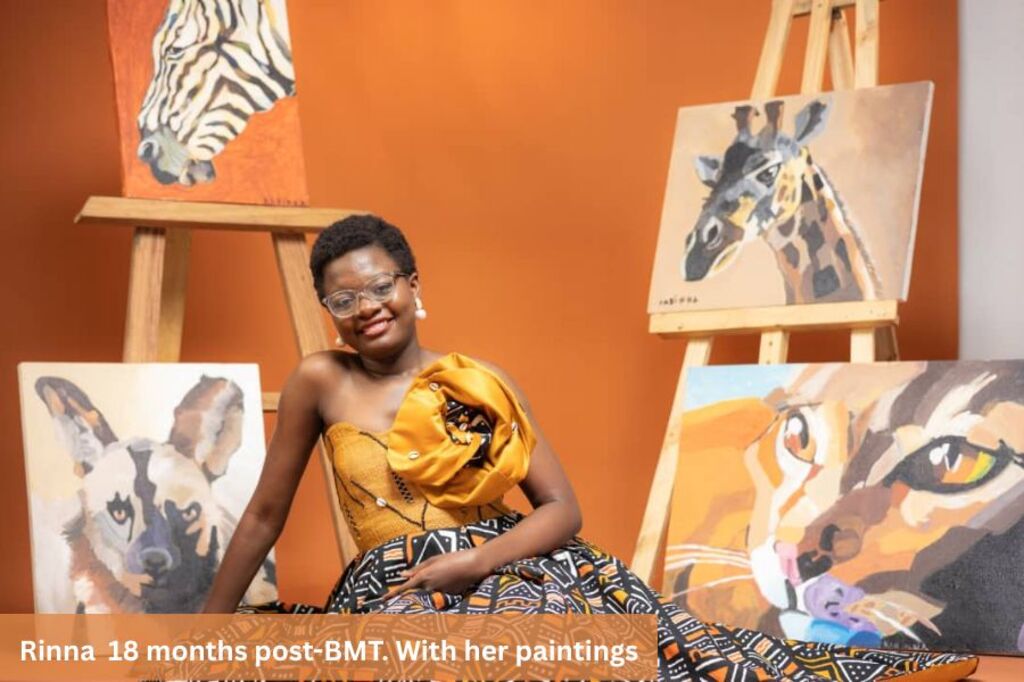
Her love for art remained intact. During this 100-day period, she created a piece of art highlighting her gratitude and appreciation for all the people who, directly or indirectly, intimately contributed to the new her. This painting now adorns the wall of Dr. Gaurav's office. It expresses her courage, shared with all the other children who, like her, will find themselves in Dr. Gaurav's office for the same treatment process.
Today, Rinna is full of life. The picture of her recovery is becoming clearer each day. The transplant marked a new chapter for her. A true rebirth. I returned to Congo with a new Rinna, full of energy, liberated from the chains of sickle cell disease that had weighed so heavily on her and our entire family.
This long and arduous journey, marked by pain, uncertainty, sacrifices, but also by unwavering determination and unconditional love, led to a resounding victory.
Rinna's testimony is that of a family who united their strength in the face of adversity, and who, thanks to the expertise of dedicated medical professionals like Dr. Gaurav Kharya and his team, and to advances in bone marrow transplant science, were able to offer Rinna a new chance, a life full of promise.
As Rinna herself so aptly put it, with the strength and optimism that now characterize her:
"Make way for the new me!"
Her story is a message of hope for all families facing sickle cell disease, proving that resilience, active pursuit of solutions, and family support can lead to miracles. It is a powerful reminder of the importance of never giving up the fight for the health and well-being of our loved ones.